
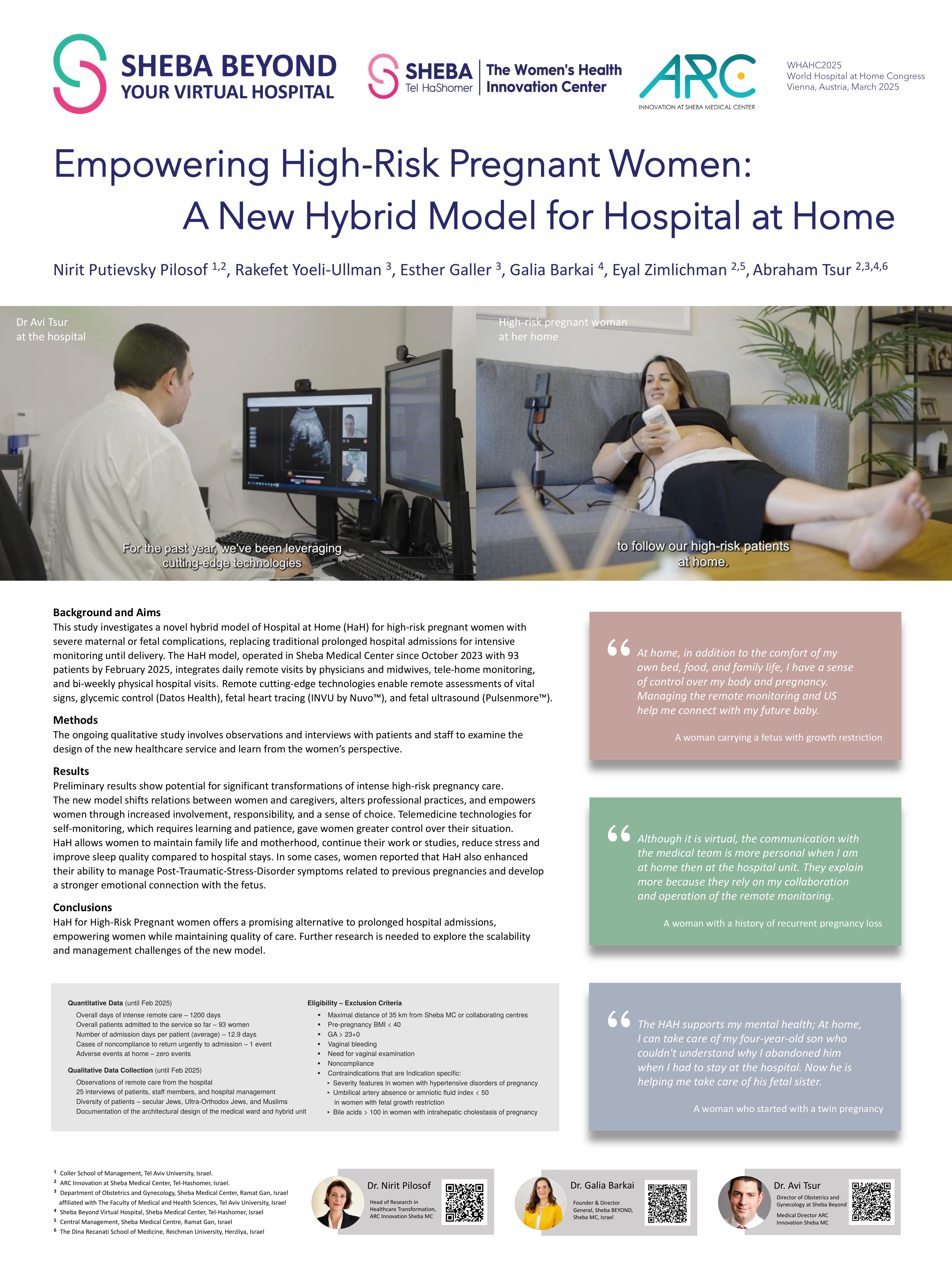
At the World Hospital at Home Congress, held on 27–29 March 2025 at the Austria Center Vienna, a team from Sheba Medical Center in Israel presented a poster on a new way to care for women with high-risk pregnancies: at home, instead of in a hospital bed. Among the tools that make it possible is INVU by Nuvo, used for fetal heart tracing at home.
Hospital at home for high-risk pregnancy
 Open the poster full size ↗
Women with severe maternal or fetal complications are often admitted to hospital for intensive monitoring until they give birth, sometimes for weeks. Since October 2023, Sheba has offered them an alternative: daily remote visits by physicians and midwives, monitoring at home, and regular visits to the hospital in person.
The monitoring is done remotely: vital signs, blood glucose, fetal ultrasound, and fetal heart tracing with INVU. The poster, “Empowering high-risk pregnant women: a new hybrid model for hospital at home”, was written by Nirit Putievsky Pilosof, Rakefet Yoeli-Ullman, Esther Galler, Galia Barkai, Eyal Zimlichman and Abraham Tsur.
The first 93 women
By February 2025, 93 women had been cared for this way: 1,200 days of intensive care at home, 12.9 days per woman on average. There were no adverse events at home. In one case a woman did not come back promptly when asked to return to the hospital.
At home, in addition to the comfort of my own bed, food, and family life, I have a sense of control over my body and pregnancy.
The study itself is qualitative. The team observed remote care from the hospital and interviewed 25 patients, staff members and managers. Women described a greater sense of control over their pregnancy, better sleep and less stress, and being able to keep up family life, work or study. Some said it helped them feel closer to their baby.
The authors conclude that hospital at home is a promising alternative to long hospital stays for high-risk pregnant women, and that more research is needed on how to scale and run it. The model was later described in full in Frontiers in Digital Health (2026).
Hospitalised at home: how Sheba redesigned care for high-risk pregnancy →
Every other week from home: Sheba’s hybrid care for gestational diabetes →
How INVU works →
Talk to us about remote monitoring for your practice →