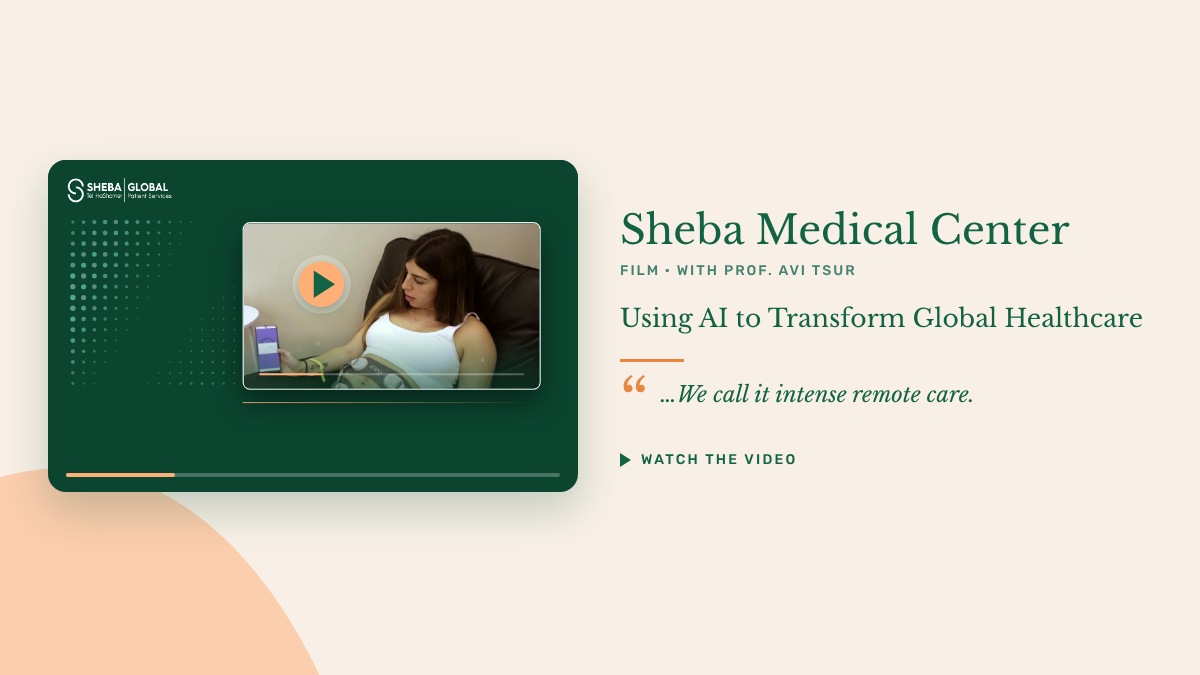
Pregnancy is a delicate journey, and modern medicine looks after it in hospitals and clinics. But what happens when those buildings are no longer safe? What happens when women already admitted for high-risk conditions, such as preeclampsia or fetal growth restriction, are told they must go home now because the hospital is under threat from missiles?
The answer sounds simple, but it took years of work to make it possible. This is Nuvo’s account of how Sheba Beyond, the virtual hospital of Sheba Medical Center, brought the hospital to pregnant women at home with INVU, and how an emergency became a way of working.
If you cannot bring the pregnant mom to the hospital, bring the hospital to the pregnant mom!
October 2023: the ward had to empty
In the days after 7 October 2023, Sheba Beyond Maternity Care was told to clear its maternity ward to make room for the expected casualties. Sending women with high-risk pregnancies home without monitoring would have put them and their babies at risk.
Sheba Beyond was already running a clinical study with INVU, a wearable that lets a woman record her baby’s heart rate and her contractions at home and sends the readings to her clinicians. Israel’s Ministry of Health fast-tracked its use for sending high-risk patients home, on the strength of that study and of the clinical evidence behind INVU’s U.S. FDA clearance.
Since then, women who would otherwise have stayed on the ward have been cared for at home or at work, with full medical oversight and clinicians watching their readings remotely. Sheba Medical Center announced the expansion in December 2023. The experience became the basis of further research: Sheba’s hybrid care was published in the International Journal of Gynecology & Obstetrics (2025) and presented at the World Hospital at Home Congress in Vienna (March 2025).
June 2025: from emergency to a way of working
When missiles struck again in June 2025, including the hit on Soroka Medical Center, hospitals moved more care home, department by department.
From its command-and-control centre, Sheba Beyond can follow women sent home from its own wards and from other hospitals, and one nurse there can follow more women than at the bedside. Sheba has also offered other hospitals in Israel the chance to learn its command-centre set-up and copy it.
A woman who is worried about her baby and would otherwise go to the emergency room can have an INVU check at home. If needed, the centre’s physician enrols her in home monitoring for a while or for the rest of her pregnancy.
What it could mean in the U.S.
INVU is FDA-cleared and already in use in the U.S. The same approach could help in four places:
- Fewer unplanned emergency visits. Many obstetric emergency visits are for reassurance monitoring that a nonstress test at home can cover.
- No hospital stay just for monitoring. Women with conditions such as preeclampsia or growth restriction are sometimes admitted mainly for daily nonstress tests. At Penn Medicine, 93.9% of home appointments gave a test clinicians could read, and 88.5% finished without a clinic visit.
- Care where there is none. About 2.2 million women of childbearing age live in maternity care deserts, counties with no hospital offering obstetric care and no obstetric providers (March of Dimes, 2022). Banner Health has used remote NSTs in its rural programme.
- Lower cost. A test at home avoids keeping a hospital bed only for monitoring.
Ambulance or home-visit teams carrying INVU could also check the baby on the spot, so a worried mother is seen quickly without an emergency-room admission and, if needed, starts home monitoring straight away.
Sheba in its own words
- Sheba Beyond’s breakthrough in remote pregnancy monitoring (Sheba, December 2023). Sheba describes one patient whose pregnancy continued from week 32 to week 37, when doctors had expected to deliver at week 34.
- Israel’s top hospital ups remote pregnancy care in wartime (NoCamels, December 2023).
Read more
- Between October 2023 and December 2025 the unit recorded 206 admissions and 2,998 days of hospital-level care at home: Hospitalised at home, Frontiers in Digital Health, 2026.
- What this could mean beyond wartime: Redefining pregnancy care in times of crisis, and beyond, by Sandy Hammer.