
Electrical & mechanical validation
Combines fetal electrical activity (fECG) with mechanical signals (fPCG) to cross-check every event. This enables higher confidence in fetal heart assessment, even in real-world conditions.
Nuvo has amassed the world’s most comprehensive longitudinal dataset of real-world pregnancy physiology, combining multichannel native fetal and maternal electrophysiology and phonocardiography at unprecedented scale.
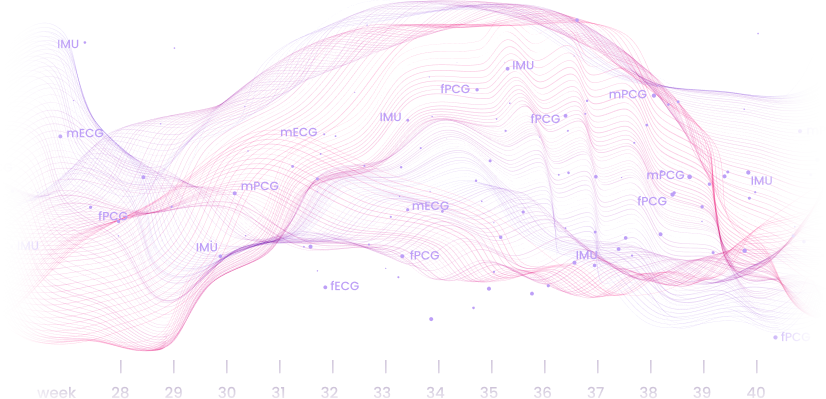
Collected from live pregnancies
Built at unprecedented scale across live pregnancies—enabling broader coverage, stronger generalization, and more reliable validation than typical research datasets.
Synchronized fetal and maternal ECG and PCG signals, plus IMU motion context, provide cross-validation across modalities and unlock deeper physiological insights.
Continuous, repeat monitoring over time captures how fetal and maternal patterns evolve across weeks and supporting progression-based analysis, not single snapshots.
Collected from live pregnancies in real-world settings, reflecting the variability and artifacts that clinical AI must handle—making models more robust and clinically relevant.
Dataset |
Live Pregnancies |
Modalities |
Scale |
Longitudinal |
|---|---|---|---|---|
|
INVU™ Data Lake |
Yes |
Multimodal (fECG, mECG, fPCG, mPCG, IMU) |
350,000+ minutes, 25,000+ sessions |
Yes |
|
PhysioNet fECG |
Limited |
fECG only |
Small research sets |
No |
|
Academic fPCG Sets |
Rarely |
fPCG only |
Small research sets |
No |
Historically, publicly available pregnancy datasets have been limited in size, modality, and continuity. Nuvo’s platform uniquely combines real-world scale with synchronized multimodal signals and longitudinal depth.
Combines fetal electrical activity (fECG) with mechanical signals (fPCG) to cross-check every event. This enables higher confidence in fetal heart assessment, even in real-world conditions.
Maternal ECG and PCG provide essential context to separate fetal signals from maternal physiology and motion. This improves signal quality, reduces artifacts, and supports safe, accurate monitoring.
Time aligned signals enable beat-to-beat coupling between electrical and mechanical activity. This strengthens model robustness and supports more reliable detection of subtle changes over time.
Each individual signal captures a different layer of maternal–fetal physiology. Together, they enable richer interpretation and more robust AI modeling. By combining electrical, mechanical, and motion context, the INVU(tm) multimodal platform enables deeper physiological insights and stronger clinical-grade AI performance.
Click each signal to learn what it captures:
The fetal ECG captures the baby’s electrical heart activity. It supports beat-to-beat heart rate, heart rate variability, and can help detect rhythm irregularities—providing a direct, high-fidelity view of fetal cardiac function.
The maternal ECG provides essential context for separating fetal signals from maternal physiology and noise. It improves artifact removal, enables cleaner extraction of fetal activity, and can also surface maternal cardiovascular insights that matter during pregnancy.
Fetal PCG measures the mechanical and acoustic signature of the fetal heart. It reflects contractility and hemodynamics, complements fECG, and helps validate timing and strength of cardiac events—adding a critical mechanical layer to interpretation.
Maternal PCG captures maternal heart sounds and mechanical activity. It supports signal separation, improves robustness in real-world monitoring, and adds additional context that strengthens overall quality and safety.
The IMU provides motion and orientation data, helping the system understand when movement affects signal quality. This contextual layer supports artifact detection, improves reliability, and enables smarter filtering and interpretation during everyday use.
INVU™ synchronized, multimodal dataset is built for modern AI. By combining multichannel physiology, motion context, and structured metadata at scale, it enables more robust learning, validation, and continuous model improvement.
Learn richer patterns across fetal and maternal electrical and acoustic signals.
Pre-train on large-scale physiology to unlock multiple downstream tasks.
Scale learning with real-world outcomes and lightweight clinical annotations.
Use synchronized modalities to guide labeling and strengthen reliability.
IMU context supports artifact detection and more robust interpretation.
Build pregnancy-specific representations that can’t be derived from other platforms.
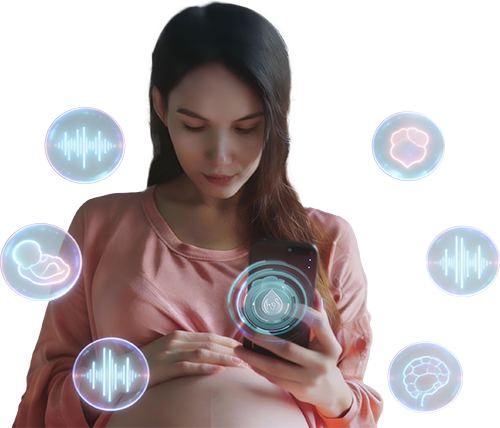
INVU™ is not a point solution—it’s a continuously learning platform. By capturing synchronized fetal and maternal ECG, heart sounds, and motion at scale, it turns pregnancy monitoring into a data-driven continuum that enables new insights over time.
AI-powered NSTs that translate complex signals into actionable assessments of fetal well-being (fHR, mHR, MUA).
Early distress detection, maternal cardiovascular changes, placental function signals, risk stratification, and longitudinal markers previously invisible in standard care.
Traditional fetal monitoring relies on Doppler ultrasound, which infers heart rate from motion or blood flow. INVU™ captures native fetal ECG (fECG) directly, and—together with synchronized PCG and IMU—enables physiological validation and motion-aware quality control that Doppler-based systems cannot provide.
Native fECG enables beat-to-beat precision, waveform morphology, conduction intervals, and signal stability.
|
|
INVU’s™ Native fHR |
Doppler / Ultrasound-Derived fHR |
|---|---|---|
|
Signal Source |
Direct electrical activity of fetal myocardium |
Mechanical motion / blood flow |
|
Waveform Fidelity |
Full ECG morphology (P, QRS, T) |
No waveform; rate only |
|
Signal Continuity |
Continuous, beat-to-beat |
Intermittent, motion-sensitive |
|
AI Readiness |
High – labeled, structured electrophysiology |
Low – indirect and noisy |
|
Clinical Depth |
Arrhythmias, variability, conduction analysis |
Heart rate trend only |
Together, this creates a compounding advantage for clinical validation, partnerships, and category leadership.
Built over years across thousands of live pregnancies with continuous, synchronized multichannel capture—depth that can’t be accelerated or recreated retrospectively.
Generated under regulated workflows with FDA-cleared hardware and compliant quality systems—critical for clinical AI and evidence.
Prospective consent supports continuous monitoring and secondary data use; retrospective archives often lack rights for AI training and commercialization.
A tightly integrated wearable–software–cloud system enables native signal fidelity, continuity, and multimodal synchronization—advantages software alone can’t replicate.