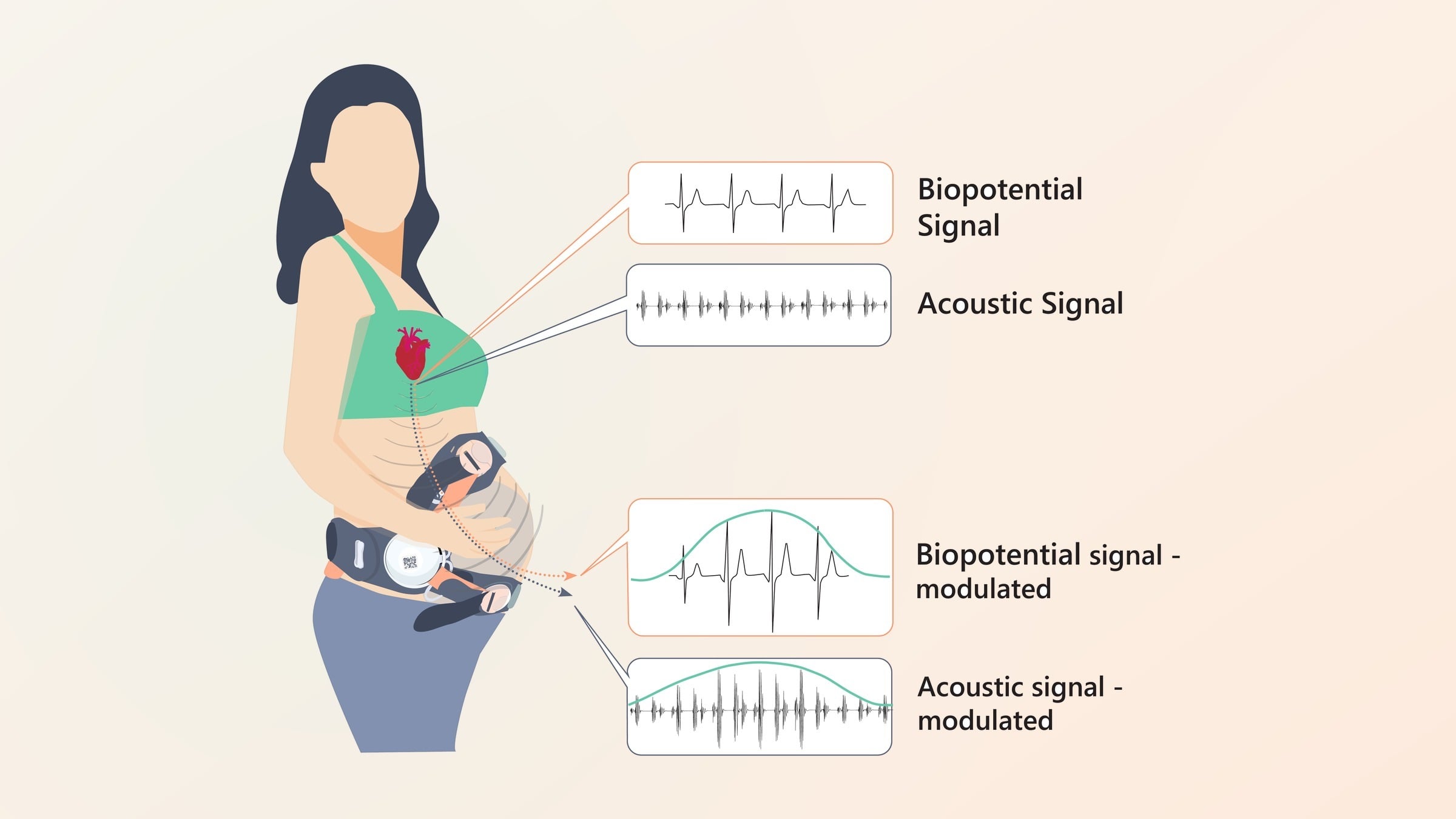
INVU has no pressure sensor. This paper explains how it still sees contractions: when the uterus tightens, it changes how the mother’s heartbeat travels to the skin, so the electrical and sound signals the belt already records rise and fall with each contraction. The team then tested the method in two groups of women, in labour and before it.
Why it was studied
Contractions are measured in two ways today. The catheter inside the uterus (IUPC) is the most accurate, but it can be placed only in labour, after the waters have broken. The external belt (tocodynamometer, TOCO) presses on the abdomen; a nurse has to place it, and it loses contractions with movement, belt position and a higher body mass index. Neither can be used by a woman at home. INVU already read the baby’s and the mother’s heart rate; a full nonstress test also needs contractions.
How it works
The belt carries 8 electrical and 4 acoustic sensors and sends no energy into the body. When the uterus contracts, its tissue changes shape and texture, and the mother’s heartbeat, both its electrical signal and its sound, reaches the skin a little differently. The software, called CaBUM (cardiac-based uterine monitoring), measures the height of every maternal heartbeat on each channel, weighs the channels by how clearly they show contractions, and blends them into one contraction trace, updated every minute. The belt’s motion sensor is used to filter out movement that looks like a contraction. The method is FDA-cleared (K210025).
How it was tested
In labour: 41 women at 32 weeks or later who already had a catheter for their care, at the University of Arkansas and Penn Medicine, wore INVU alongside it for 30 to 60 minutes; 10 of them also wore TOCO. A computer program, not a person, marked the contractions on every trace.
Before labour: 147 women at Hadassah, Heidelberg University Hospital, Penn Medicine and Eastern Virginia Medical School wore INVU and TOCO together for 30 minutes, put on by research staff. The 16 who had at least one clear contraction on TOCO were analysed.
What they found
- In labour: INVU found 500 of the 557 contractions on the catheter (89.8%). 8.6% of the contractions INVU marked were not on the catheter.
- Against the standard belt (10 women with all three): INVU found 126 of 135 catheter contractions (93.3%), TOCO 52 (38.5%). INVU’s trace also followed the shape of the catheter trace far more closely (correlation 0.76 vs 0.35). TOCO raised fewer false alarms: 1.9% against 9.1%.
- Body size: INVU did as well in women with obesity (89.8%) as in women of normal weight (85.9%); TOCO did worse at higher BMI. The groups were small, and the authors call it a trend.
- Before labour: INVU found 89 of the 95 contractions marked on TOCO (94%). It also marked 40 that TOCO did not (31.1%); with no catheter before labour, nobody can say which device was right.
Why it matters
This is the engineering behind INVU’s contraction reading. The clinical test of the same method, with blinded specialists, is in Improved uterine contraction detection compared with conventional TOCO (AJOG 2022); heart rate is in the 2020 validation. Together they make the full nonstress test from a belt a woman can put on herself, which Penn Medicine then used at home with high-risk patients.
What it does not show
The women in labour already needed a catheter, so they were a particular group, and many had an epidural, which keeps people still and may have helped INVU. The two belts were worn together and may have got in each other’s way; TOCO did worse here than in other studies. Only 10 women wore all three devices. Before labour there was no catheter to settle which device was right, and only sessions with a contraction visible on TOCO were counted. Staff put the belt on in hospital; home use was tested later.
Who ran it
Four of the eight authors worked for Nuvo, which developed the method and paid for editorial support; the others are clinical investigators at Hadassah, Heidelberg, Penn Medicine and Eastern Virginia Medical School. Registered as NCT03889405 (labour) and NCT03504189 (before labour). Published open access under a CC BY licence.
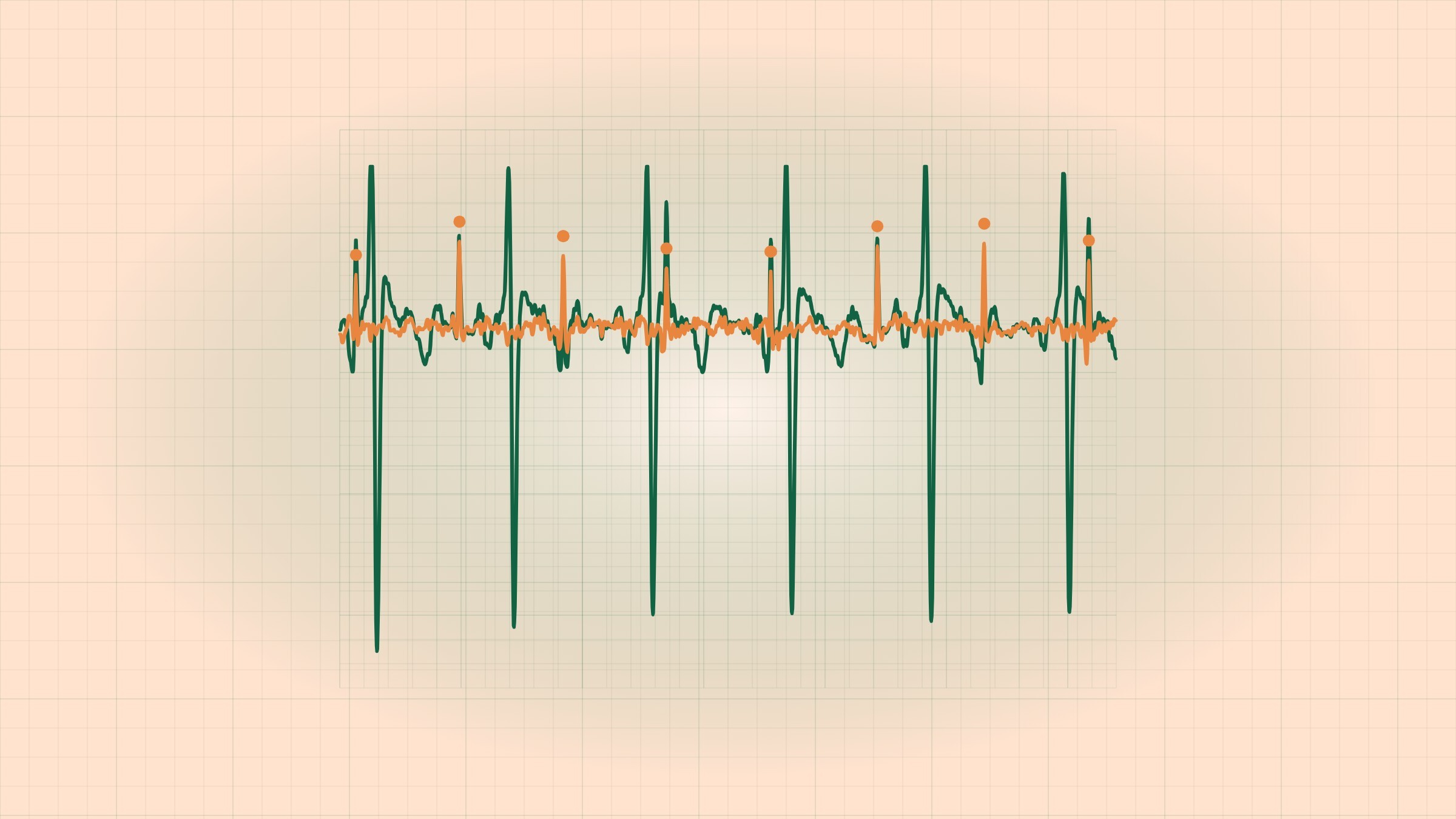
Cover image: adapted from Figure 8 of Mhajna et al., Front Bioeng Biotechnol 2022 (CC BY); colours changed.
Mhajna M, Sadeh B, Yagel S, Sohn C, Schwartz N, Warsof S, Zahar Y, Reches A. Front Bioeng Biotechnol 2022;10:933612.
doi.org/10.3389/fbioe.2022.933612