
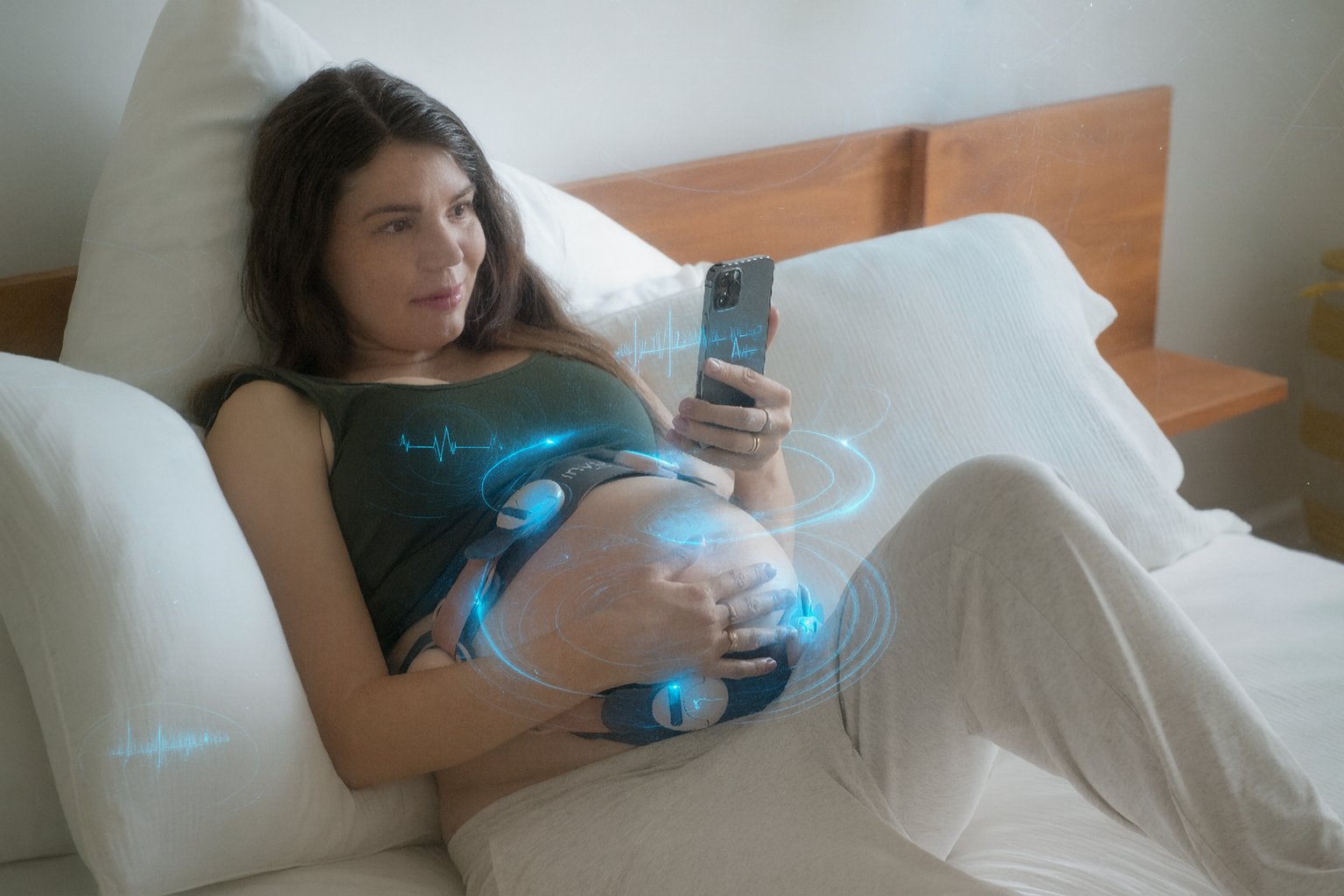
INVU™: The Most Advanced Next-Generation NST

Introduction
Non-Stress Tests (NSTs) are a cornerstone of fetal surveillance, particularly in high-risk pregnancies where frequent and reliable assessment is required. Traditionally, NSTs are performed using cardiotocography (CTG), a clinical monitoring system that relies on Doppler ultrasound to infer fetal heart rate from mechanical motion. While this approach has enabled widespread clinical use, it is inherently indirect and introduces structural limitations in signal fidelity, workflow efficiency, and scalability.
The INVU platform represents a fundamentally different, modern and more advanced approach. By capturing fetal cardiac activity using a multimodal sensing architecture centered on direct fetal electrocardiography (fECG), complemented by phonocardiography (PCG), and delivered through a remote monitoring model, INVU reframes how NST data are acquired, interpreted, and utilized. The differences outlined below are not incremental performance claims but arise from this foundational shift in sensing modality and care delivery model.
Signal Acquisition
Traditional NSTs performed with CTG rely on Doppler ultrasound to infer fetal heart rate by detecting mechanical motion associated with cardiac activity. Because the signal is derived indirectly, it is highly sensitive to probe placement, fetal movement, and maternal anatomy.
INVU employs a fundamentally different acquisition strategy. Fetal cardiac activity is captured directly at the source using abdominal electrodes to record fetal electrocardiography (fECG), with complementary phonocardiography (PCG) providing an independent acoustic representation of the same cardiac events. By measuring intrinsic electrical activity rather than inferred motion, and by incorporating multimodal cardiac signals, INVU establishes a physiologically grounded and timing-accurate foundation for fetal heart rate assessment.
Signal Reliability
Because CTG-based NSTs rely on Doppler ultrasound, signal quality is tightly coupled to mechanical transmission conditions, including probe placement, maternal body habitus, fetal position, and motion. In routine clinical practice, these dependencies frequently lead to signal dropout, repeated repositioning, and the need for ongoing staff intervention to maintain an interpretable tracing.
INVU’s reliance on direct electrical cardiac signals fundamentally alters this reliability profile. Electrical signal acquisition is less constrained by acoustic coupling and probe orientation, enabling more stable performance across a broad range of body types and physiological conditions. As a result, monitoring continuity is improved, interruptions are reduced, and NST acquisition becomes less dependent on constant operator adjustment.
Beat-to-Beat Variability
Assessment of short-term fetal heart rate variability is a core component of NST interpretation and provides insight into autonomic nervous system activity. In CTG-based systems, this variability is derived from motion-based Doppler signals that are inherently noisy and irregular, often necessitating temporal smoothing or interpolation to produce a stable tracing suitable for clinical review.
INVU derives heart rate timing directly from fetal electrocardiography (fECG), where each cardiac cycle is defined by a discrete electrical event. While traditional NST interpretation does not require true beat-level precision, electrical timing provides an intrinsically stable and physiologically grounded representation of short-term variability. This reduces ambiguity related to signal processing artifacts and supports greater confidence in variability assessment during routine NST review.
Direct Without Artifact Susceptibility
CTG-based NST recordings are prone to artifacts such as signal dropout, motion interference, and confusion between maternal and fetal heart rates, reflecting the limitations of motion-based Doppler sensing. Because these artifacts can be difficult to distinguish from true physiological changes, interpretation often requires repeat monitoring or additional follow-up.
INVU captures direct fetal electrocardiography (fECG), supported by complementary phonocardiography (PCG). Maternal and fetal ECG signals exhibit distinct electrical characteristics, including differences in amplitude and timing, which INVU’s signal processing pipeline is designed to exploit. This improves maternal–fetal signal separation, reduces artifact-related ambiguity, and supports clearer NST interpretation.
Flexible Care Setting
Traditional NSTs are largely confined to clinic or hospital settings, reflecting the need for specialized equipment, continuous probe adjustment, and trained personnel to maintain signal quality. By contrast, INVU’s direct, wearable sensing approach enables NSTs to be performed reliably outside the clinic, including in the patient’s home, without sacrificing signal integrity. This decoupling of NST acquisition from physical care settings expands where and how fetal surveillance can occur while preserving clinical interpretability.
Workflow Efficiency
Clinic-based NSTs require dedicated room time, equipment, and ongoing staff involvement to establish and maintain an interpretable tracing, placing a nontrivial operational burden on busy practices. These demands scale linearly with patient volume and contribute to scheduling constraints and clinical bottlenecks.
By enabling NST acquisition to be self-administered and reviewed remotely, INVU shifts clinician involvement from real-time signal maintenance to asynchronous interpretation. This reduces dependence on in-clinic resources, alleviates workflow congestion, and allows clinical staff to concentrate on higher-acuity care.
Better Patient Experience
Frequent in-clinic NST visits can be logistically burdensome for patients, particularly in high-risk pregnancies requiring repeated monitoring, and may impact adherence over time. By enabling NSTs to be performed in the home, INVU reduces access and logistical barriers, supporting adherence to recommended surveillance schedules without changing the clinical intent of the test.
Scalability
Scaling traditional, clinic-based NST services requires proportional increases in staff time, equipment, and physical space, limiting expansion as patient volume grows. These constraints are inherent to in-person monitoring workflows.
INVU’s remote and self-administered acquisition model decouples NST volume from physical infrastructure and real-time staffing requirements. As a result, fetal surveillance can be expanded across practices and health systems without linear growth in clinical resources, supporting population-scale and longitudinal monitoring.
Advanced Data Utility
Traditional NST data are episodic, generated for point-in-time clinical assessments and rarely reused beyond the immediate encounter. As a result, longitudinal analysis and cross-patient learning are limited.
By enabling frequent, repeatable NST acquisition using a multimodal sensing architecture, INVU produces longitudinal physiological datasets that extend beyond isolated tracings. This continuity supports trend analysis across time, population-level characterization, and the foundation for future analytics and decision-support capabilities that are not feasible with episodic monitoring alone.
Conclusion
INVU-based NSTs reflect a fundamental shift in how fetal surveillance is performed, addressing structural limitations inherent to Doppler-based CTG systems. By relying on direct, multimodal cardiac signal acquisition rather than motion-based inference, INVU improves signal interpretability while reducing dependence on continuous in-clinic resources.
The ability to perform NSTs reliably across care settings enables more flexible delivery, reduces operational constraints, and supports scalable deployment across patient populations. At the same time, repeated, high-quality monitoring produces longitudinal physiological data that extends the value of NSTs beyond isolated clinical encounters. Together, these characteristics position INVU not only as an alternative NST modality, but as a platform that reshapes how fetal monitoring data are generated, used, and scaled.
INVU™: NST: More Advanced than Traditional NSTs
|
Dimension |
Traditional Doppler / CTG NST |
INVU™ NST |
|
Signal Acquisition |
Indirect measurement via ultrasound Doppler detecting motion |
Direct measurement via fetal ECG & PCG |
|
Signal Reliability |
Highly dependent on fetal position, maternal BMI, and probe placement |
Consistent signal quality across BMI ranges and fetal positions |
|
Beat-to-Beat Variability |
Often smoothed or approximated |
High-fidelity, true beat-to-beat variability |
|
Artifact Susceptibility |
Frequent signal dropouts and maternal heart rate confusion |
Improved separation of maternal and fetal signals |
|
Care Setting |
Clinic-based only |
Home-based or clinic-based |
|
Workflow Efficiency |
Requires staff, equipment, and room time |
Self-administered with remote clinician review |
|
Patient Experience |
Time-consuming visits and logistical burden |
Convenient, comfortable, and promotes adherence |
|
Scalability |
Limited by physical resources |
Highly scalable digital workflow |
|
Data Utility |
Episodic snapshots, limited reuse |
Longitudinal, multimodal dataset for analytics and AI |